For global buyers, choosing the best Expensive Hand Luggage involves more than admiring a polished shell. It requires careful judgment, practical testing, and honest comparison.
Dieter Morszeck, a luggage-industry veteran and former Rimowa leader, once described luggage as “a companion for life.” That idea remains useful. Premium hand luggage should move smoothly through crowded terminals, fit securely beneath approved cabin limits, and protect belongings during repeated journeys. Its value appears in details: quiet spinner wheels, a firm telescopic handle, balanced weight, strong zippers, and an interior that does not waste space.
Luxury materials attract attention. Aluminum offers a distinctive finish and visible durability. Lightweight polycarbonate may reduce lifting strain. Leather accents can improve touch and appearance, but they may require more care. Small differences matter.
Price alone can mislead.
This guide examines China’s leading expensive hand luggage options for international customers. It considers manufacturing quality, design consistency, after-sales support, warranty clarity, and long-term repair access. Buyers should also check airline cabin dimensions, because policies differ between carriers and routes. A beautiful case that fails a cabin-size check quickly becomes an inconvenient purchase.
The comparison will not pretend that one suitcase suits everyone. Frequent business travelers may value organization and silent wheels. Luxury shoppers may prioritize finish and brand heritage. Long-distance travelers may prefer lighter construction.
Even expert opinions have limits. Product batches can vary, and marketing claims deserve verification. The strongest choice is not always the most expensive one. It is the case that performs reliably, travels comfortably, and still looks dependable after many departures.
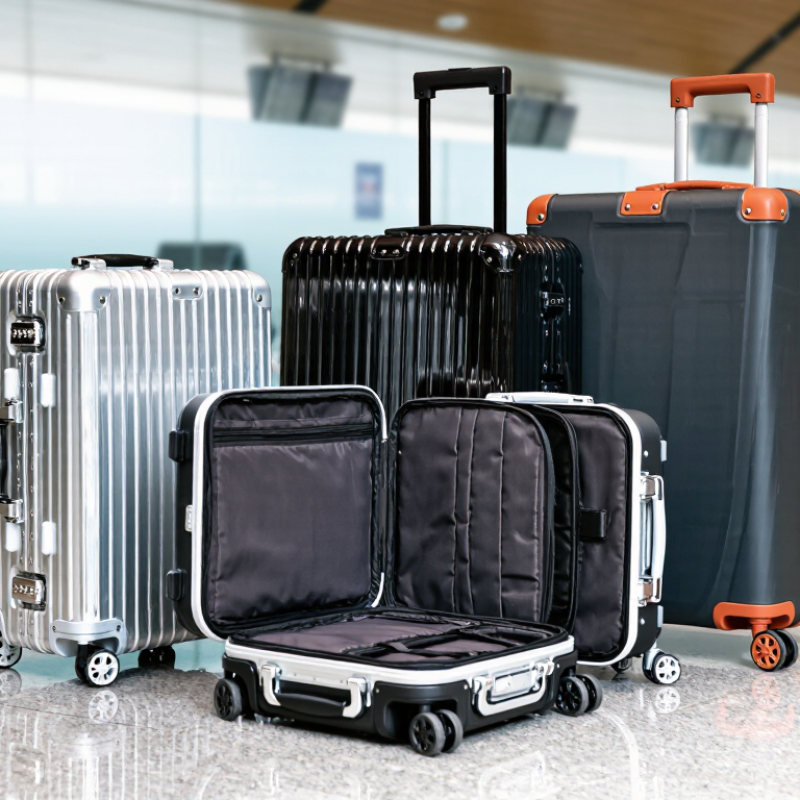
Premium hand luggage made in China is defined by controlled details, not a low production cost. Experienced buyers inspect the shell, frame, wheels, handle, lining, and hardware separately. A strong polycarbonate shell should resist practical impact without becoming unnecessarily heavy. Corners need clean reinforcement, especially around the wheel housings. The telescopic handle should move smoothly, with limited side-to-side movement. Details matter.
Reliable factories test more than appearance. They may perform drop tests, wheel-rolling trials, handle-load tests, and repeated zipper cycles. These checks reveal weaknesses that photographs cannot show. Buyers should request material specifications, inspection records, and production samples from the same manufacturing line. Traceable quality records also support consistent purchasing across different order sizes. Clear communication about dimensions, capacity, packaging, and replacement parts reflects professional supplier management.
However, premium quality is not automatic. A polished sample can hide uneven assembly during mass production. I have seen attractive cases with noisy wheels and handles that loosened too quickly. That is not enough. Buyers should compare several samples, inspect internal stitching, and test the case under realistic travel conditions. Factory capability, honest reporting, responsive after-sales support, and documented quality control define confidence more than the country of origin alone. A small flaw should be recorded, questioned, and corrected before shipment.
High-end Chinese hand luggage is increasingly judged by material discipline, not decoration. Grand View Research estimated the global luggage market at about USD 22 billion in 2023, with premium travel products gaining attention. This growth raises a practical question: what deserves a higher price?
Premium cases often use German-grade polycarbonate blends, aerospace-style aluminum alloys, or reinforced nylon shells. Polycarbonate reduces cracking after repeated impacts, while aluminum offers a firmer frame and a cooler, heavier feel. Material thickness still matters. A shiny shell can hide weak corners. It happens.
In supplier inspections, buyers should check wheel noise, handle wobble, zipper alignment, and corner compression. These details reveal more than showroom lighting. The International Air Transport Association reports that mishandled baggage remains a measurable operational concern, so smooth-rolling wheels and secure closures are not minor luxuries. Sealed bearings, replaceable wheel units, and impact-tested telescopic handles improve long-term value. A reliable interior also matters. Dense lining, compression panels, and separated compartments protect clothing without wasting cabin space. According to a 2024 luggage market analysis by Mordor Intelligence, durability, lightweight construction, and smart organization are major purchase factors. However, “smart” features need restraint. Built-in tracking or charging systems may add convenience, but they also add weight and maintenance points. High-end Chinese luggage can be excellent, yet buyers should request test records, material specifications, and warranty terms before trusting the price. Fancy hardware is not proof.
Material density is a practical indicator of potential shell weight. Premium luggage typically balances low density with impact resistance, rigidity, surface durability, and precise hardware construction.
Typical engineering density values are shown in grams per cubic centimeter. Polycarbonate and nylon can help reduce weight, while aluminum alloy provides higher rigidity at a greater material density. Actual luggage weight also depends on shell thickness, frame design, lining, wheels, handles, and hardware.
When comparing China’s leading luxury hand luggage makers, price is only one signal. Grand View Research valued the global luggage market at approximately USD 36.47 billion in 2023, showing strong demand but intense competition. I examine shell materials, wheel stability, handle alignment, lining quality, and repair access. A polished showroom can hide weak components.
Bain & Company and Altagamma estimated the global personal luxury goods market at about €362 billion in 2023. This supports a higher standard for finishing and service. Ask for independent test records, not only factory photographs. Check abrasion results, zipper-cycle testing, corner-impact performance, and cabin-size accuracy. Small differences matter at airport counters.
Supplier experience also matters. I prefer manufacturers that provide traceable material certificates, documented quality inspections, and clear warranty terms. A three-year warranty sounds useful, but exclusions may cover the parts most likely to fail. That deserves scrutiny. I also compare sample consistency across several production units, because one excellent case proves little. Buyers should request shipping weight, wheel replacement costs, and lead times in writing. Some comparisons remain imperfect, especially when test methods differ between suppliers. Still, transparent evidence is more reliable than luxury wording.
| Comparison Dimension | Standard Luxury Benchmark | Premium Luxury Benchmark | What Global Buyers Should Verify |
|---|---|---|---|
| Typical cabin size | Approximately 55–56 × 35–40 × 20–23 cm | Approximately 55–56 × 35–40 × 20–23 cm, with tighter dimensional control | Airline limits differ by route and carrier. Confirm external dimensions, including wheels and handles, before purchase. |
| Empty weight | About 2.8–3.8 kg for a cabin case | About 2.5–3.5 kg, depending on shell, frame, lining and hardware | Request a production-weight tolerance and a sample weighed with all permanent components installed. |
| Hard-shell material | Polycarbonate or a polycarbonate-based construction | Higher-grade polycarbonate, aluminium frame, or a mixed-material construction | Check the exact material grade, shell thickness, recycled content, and whether the stated material applies to the complete shell. |
| Frame and closure | Zipper closure with reinforced corners | Aluminium frame or reinforced zipper system with replaceable seals | Inspect corner alignment, closure compression, water-resistance design and spare-part availability. |
| Wheel configuration | Four double spinner wheels with replaceable wheel housings | Low-noise dual spinner wheels using higher-durability wheel compounds | Ask for wheel material, rolling-load test results, replacement procedure and spare-wheel pricing. |
| Telescopic handle | Two- or three-stage aluminium handle with moderate lateral movement | Reinforced aluminium handle with smoother locking and lower play | Verify extension-cycle testing, handle wobble tolerance and compatibility with the case shell. |
| Interior organization | Lined compartments, divider panel and compression straps | Removable organizer, premium lining, garment section and compression system | Check lining abrasion resistance, stitching density, odor, cleanability and actual usable volume. |
| Security features | Integrated combination lock or compatible external lock | Integrated lock with improved hardware finishing and tamper-resistant construction | For United States-bound products, verify whether the lock is accepted by TSA inspection procedures. |
| Surface finishing | Scratch-resistant textured or fine-grain finish | More consistent coating, anodizing or polished hardware finish | Compare color consistency, coating adhesion, edge finishing and resistance to visible scuffing. |
| Quality-control evidence | Pre-shipment inspection and basic functional checks | Documented incoming-material, in-process and final inspections | Request inspection records, defect classifications, sample approval procedures and corrective-action reports. |
| Compliance documentation | Material declarations and export packaging information | Material traceability, restricted-substance declarations and market-specific documents | Match documentation to the destination market, packaging rules, chemical restrictions and labeling requirements. |
| Warranty expectation | At least 1 year for manufacturing defects | Typically 2 years or more, with clearer component coverage | Clarify coverage for wheels, handles, locks, shell damage, shipping claims and labor. |
| Replacement-part support | Common parts available on request | Planned parts catalog with longer availability | Confirm stock policy, international shipping method, part compatibility and service response time. |
| Customization capability | Color, lining, puller and packaging customization | Custom molds, hardware finishes, material combinations and retail packaging | Obtain tooling fees, minimum order quantities, sample charges, intellectual-property terms and approval timelines. |
| Best fit for global buyers | Reliable premium appearance with controlled procurement cost | Higher perceived value, stronger hardware presentation and longer service expectations | Select the option that meets destination-airline rules, after-sales requirements, target retail positioning and total landed cost. |
Note: The specifications above are practical comparison benchmarks for premium hand luggage manufactured in China, not claims about any specific company or brand. Airline cabin-baggage limits, warranty terms, testing methods and customization conditions must be confirmed in writing for each product and destination market.
When evaluating expensive hand luggage from China, buyers should inspect more than appearance. A rigid shell should resist controlled drop tests, corner impact, abrasion, and repeated compression. Check whether wheels survive long rolling cycles on uneven surfaces. Handles need pull-force testing, not only a smooth showroom demonstration. Zippers should open evenly after repeated use, while seams must show consistent stitching and reinforcement.
Ask for a documented quality plan and batch inspection records. A factory certificate alone does not prove every suitcase is safe. ISO 9001 shows a quality management system, but it is not a product safety certificate. Independent laboratories accredited to ISO/IEC 17025 can test materials and performance more credibly.
Request full reports, sample numbers, test dates, and laboratory scope. Vague certificates deserve questions.
Material compliance also matters. Buyers should verify restricted-substance testing for plastics, coatings, adhesives, and metal parts according to the destination market. Confirm chemical declarations and traceable material suppliers. If the luggage includes electronics or a battery, check electrical safety, transport testing, labeling, and removable-battery requirements. Airline cabin dimensions are not globally identical. Verify each market and carrier separately.
During inspections, small defects often reveal larger process problems. Uneven wheel alignment, a sharp metal edge, or a loose lining should not be dismissed as cosmetic. I have seen polished samples hide weak internal frames. That lesson remains uncomfortable. Pre-shipment inspection, factory audits, and retained production samples provide stronger evidence than photographs. Still, no testing plan is perfect. Buyers should review failures honestly and adjust specifications before mass production.
Global buyers seeking premium hand luggage from China should begin with a documented supplier review. Ask for business registration, factory location, production capacity, export history, and recent quality records. A polished website proves little. Request a physical sample before discussing large volumes. Inspect wheel movement, handle locking, zipper alignment, shell thickness, lining seams, and corner protection. Roll the case across uneven flooring. Small faults appear there. Record measurements and net weight, because airline limits can affect the product’s real value. Materials should be identified clearly, such as polycarbonate, aluminum, polyester, or leather alternatives. Avoid vague terms like “luxury grade.”
Before ordering, confirm the specification in a signed purchase document. Include dimensions, color references, logo placement if applicable, component tolerances, carton size, spare-part policy, inspection standards, and production timing. A pre-shipment inspection can check random units against the approved sample. It cannot replace your own judgment. Payment terms deserve equal attention. Use traceable business channels and keep invoices, packing lists, certificates, and shipping records together. Importers should verify customs classification, duties, taxes, labeling rules, and destination safety requirements with a licensed broker or relevant authority. Requirements differ by country.
Choose shipping terms only after calculating the landed cost. Freight, insurance, port handling, customs charges, local delivery, and possible storage fees can change a cheap quotation. Compare sea, rail, air, or consolidated freight according to urgency and volume. Protect cases with corner guards and moisture-resistant cartons, especially during long transit. Ask the supplier for loading photos and carton marks. Do not rely on promises alone. No checklist is perfect. Even an approved sample may not reflect every production unit. A small trial order exposes weaknesses before cash and reputation are heavily committed. Keep communication written, specific, and easy to audit.
Premium quality comes from controlled details, not low production cost. The shell, wheels, frame, handle, lining, and hardware need separate inspection. Details matter.
Polycarbonate can resist repeated impacts without adding excessive weight. Aluminum provides a firmer frame but usually feels heavier. Thick material alone is not enough.
Check corners, wheel housings, seams, and surface alignment under bright light. A glossy shell can hide weak corners. It happens.
Request drop tests, wheel-rolling trials, handle-load tests, and repeated zipper-cycle records. These tests reveal problems photographs cannot show.
Roll the case across a hard floor and listen for grinding or rattling. Extend the handle repeatedly and check side-to-side movement. Quiet movement matters.
Examine stitching, lining density, compression panels, and compartment separation. Clothing should stay organized without losing useful cabin space. Small flaws deserve questions.
No. A good sample may hide uneven assembly later. Compare several samples and request production-line records before shipment.
Buyers should request material specifications, inspection reports, warranty terms, dimensions, capacity details, packaging information, and replacement-part policies. Clear records reduce unpleasant surprises.
Not always. They may add convenience, weight, and extra maintenance points. Simple construction can be better. I would check the real travel need first.
China’s premium hand luggage market combines refined design, practical engineering, and flexible manufacturing capabilities for global buyers. Expensive Hand Luggage made in China is typically defined by durable construction, precise stitching, smooth wheels, reliable handles, secure closures, and thoughtful interior organization. Materials such as full-grain leather, impact-resistant polycarbonate, lightweight aluminum, and high-quality recycled fabrics can distinguish high-end products, while features like reinforced corners, tracking compatibility, compression systems, and ergonomic designs improve usability and travel performance.
When comparing luxury hand luggage suppliers, buyers should evaluate material consistency, workmanship, customization options, production experience, warranty policies, and quality-control procedures rather than relying only on appearance or price. Safety and compliance checks should include accurate product specifications, testing documentation, packaging standards, and certifications required in the destination market. For international purchasing, buyers should clarify minimum order quantities, samples, payment terms, shipping arrangements, customs responsibilities, insurance, and after-sales support. Careful supplier communication and independent inspection can help global buyers obtain premium luggage with dependable quality and smoother import procedures.

Da Bai Luxury