Choosing a High End Watch Display Case involves more than selecting an attractive box. It means protecting valuable watches while presenting them with restraint and clarity. In practice, the right case should balance security, materials, visibility, and daily convenience. A solid wood frame may create warmth, while aluminum or tempered glass can provide a cleaner, modern appearance. Details matter.
Start by measuring the watches, cushions, and available shelf space. Measure twice. A case that fits today may feel cramped after a collection grows. Check whether the interior includes soft, non-abrasive cushions, stable compartments, and enough clearance for crowns or bracelets. High-quality glass should reduce distortion and help limit exposure to dust and ultraviolet light. However, glass alone does not create complete protection. Room humidity, sunlight, and handling habits still matter.
Reliable construction deserves close attention. Inspect the hinges, hinges’ alignment, clasp, lock, and base stability before judging the finish. A heavy case can feel secure, but excessive weight may reduce portability. I once considered appearance the main priority, yet repeated daily use changed my view. A beautiful case becomes frustrating when its lid opens poorly or its cushions compress quickly. Expert advice is useful, but personal needs remain important. Consider your collection’s size, room conditions, viewing angle, and maintenance routine. This guide explains how to compare these features carefully, avoid weak construction, and choose a display case that protects watches without overwhelming them. Imperfect choices happen. Thoughtful evaluation reduces them.
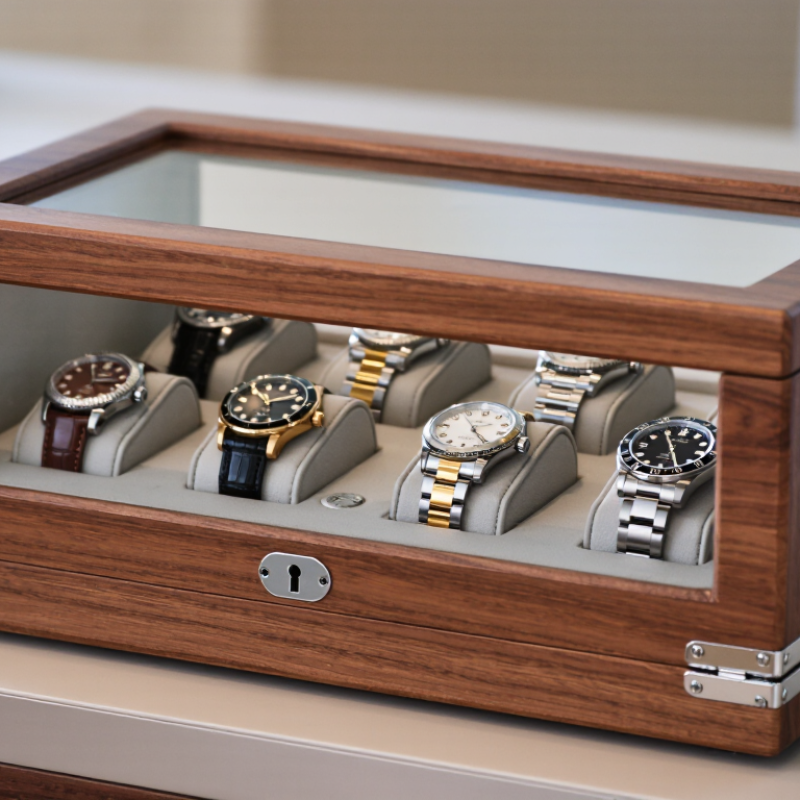
Define the Purpose and Setting of a High-End Watch Display Case
A high-end watch display case should begin with purpose, not decoration. Decide whether it will protect a daily watch, present a collection, or support careful storage. Each use demands a different interior. A collector who handles watches often needs clear access and stable cushions. A formal room may need a quieter, more sculptural case. Ask practical questions: Who will open it? How often? Where will it stand? These answers prevent an attractive but unsuitable purchase.
The setting shapes the case as much as the watches do. On a bedroom dresser, measure door clearance and leave space for removing a watch. In a study, wood, leather, or textured fabric can soften hard shelves and warm lighting. Avoid direct sunlight, damp corners, radiators, and areas with constant vibration. A lock may add reassurance, but it cannot replace sensible placement. Check the hinges, lining, and cushion firmness by hand. Small details reveal long-term quality.
Visibility must serve protection. Glass should reduce dust while allowing easy inspection without repeated opening. Ventilation matters in humid rooms, although excessive airflow can carry dust inside. I once preferred a larger case because it looked impressive, then found empty spaces made the display feel unfinished. Smaller can be better. Leave enough room between watches to prevent contact, and choose a layout that remains useful when the collection changes. A beautiful case can still fail its purpose.
Evaluate Materials, Craftsmanship, and Protective Construction
Choosing a high-end watch display case starts with its materials. Solid hardwood, metal, and low-iron glass offer different advantages. Hardwood brings warmth, but it must be sealed against moisture. Metal provides strength, yet poorly finished edges can scratch nearby objects. Low-iron glass gives clearer viewing and reduces unwanted color distortion. I always inspect the hinges, tray lining, and underside. Small details reveal larger problems.
Craftsmanship matters as much as appearance. Joints should feel tight, drawers should move without resistance, and cushions should hold watches gently. A strong case should not smell heavily of glue or solvent. That can indicate rushed production or unsuitable interior materials. Hand finishing is valuable, but it is not automatically perfect. I have seen attractive cases with uneven stitching and slightly loose fittings. Look closely.
Protective construction deserves serious attention. Select a case with a stable base, secure closures, and soft, non-abrasive compartments. Interior fabrics should resist lint and avoid chemicals that may react with metal or leather straps. A seal can reduce dust, but it cannot control a damp room. Keep the case away from direct sunlight, radiators, and sudden temperature changes. Consider whether the glass, locks, and hinges can be replaced later. That practical question is often overlooked. A display case should protect daily, not merely photograph well.
How to Choose a High-End Watch Display Case?
Evaluate materials, craftsmanship, and protective construction using a practical 100-point assessment framework. Higher scores indicate stronger suitability for long-term luxury watch display and storage.
Protective construction receives the highest weighting because UV control, dust resistance, stable humidity, secure locking, and soft interior contact directly reduce common risks such as fading, scratches, moisture exposure, and accidental impact. Material quality and craftsmanship remain essential for durability, presentation, and precise fit.
Compare Storage Capacity, Watch Fit, and Interior Organization
How to Choose a High End Watch Display Case?
Storage capacity should match your real collection, not your future fantasy. A ten-watch case may suit daily rotation, while larger collections need removable trays. The Federation of the Swiss Watch Industry reported CHF 26.0 billion in Swiss watch exports during 2024. That value deserves controlled storage, not crowded compartments. Leave one empty slot when possible. It makes handling easier and reduces accidental contact.
Watch fit matters more than impressive exterior materials. Measure each watch, including crown guards and oversized clasps. Soft cushions should compress slightly, but never force the bracelet closed. A 42-millimeter watch can sit badly in a narrow slot. Smaller watches may also tilt inside deep cushions. I once preferred firm pillows, but they placed pressure on thin straps. That choice needed reconsideration. Fit is personal.
Interior organization should create a clear visual and physical routine. Separate daily watches from delicate pieces. Use dividers between metal bracelets and polished cases. A useful case includes removable cushions, stable hinges, and enough height for automatic watches. The Deloitte Swiss Watch Industry Study 2024 continues to identify craftsmanship and product quality as key luxury-watch purchase factors. A poorly arranged interior can undermine that value. Check whether the lid closes without touching the crystals. Check the corners, too. Small details matter.
How to Choose a High End Watch Display Case? - Compare Storage Capacity, Watch Fit, and Interior Organization
| Case Type |
Watch Capacity |
Approx. Exterior Size
(W × D × H) |
Recommended Watch Size |
Cushion and Fit |
Interior Organization |
Best Use |
| Compact Single-Watch Case |
1 watch |
15 × 12 × 9 cm |
34–45 mm |
One removable cushion, approximately 50–55 mm wide, suitable for leather straps and bracelets. |
Single compartment with room for a polishing cloth or spare strap. |
Travel, desk display, or a focused presentation of one watch. |
| Two-Watch Presentation Case |
2 watches |
24 × 14 × 9 cm |
36–46 mm |
Two independent cushions with approximately 2–3 cm of separation to reduce case-to-case contact. |
Divided watch bays and a shallow accessory section for spring-bar tools or straps. |
Displaying a daily watch and a dress watch together. |
| Four-Watch Collector Case |
4 watches |
29 × 21 × 10 cm |
36–48 mm |
Four soft, removable cushions; choose adjustable cushions if bracelets have limited flexibility. |
Individual padded slots with a central divider and space beneath the lid for a care cloth. |
A small rotation of everyday, formal, and sports watches. |
| Six-Watch Display Box |
6 watches |
35 × 23 × 11 cm |
38–48 mm |
Six cushions with approximately 1.5–2 cm between neighboring watches; verify lug and crown clearance. |
Two rows of three compartments, usually with a lift-out tray or removable cushion insert. |
Collectors who want good capacity without using a large cabinet. |
| Eight-Watch Collector Cabinet |
8 watches |
39 × 25 × 13 cm |
38–50 mm |
Wide removable cushions, approximately 55–60 mm, with extra clearance for thick cases and large crowns. |
Eight separated bays, a lower accessory drawer, and a removable tray for easier access. |
A growing collection requiring organized daily access. |
| Ten-Watch Display Chest |
10 watches |
45 × 30 × 15 cm |
38–52 mm |
Extra-wide cushions and approximately 2 cm of spacing help accommodate substantial cases and bracelets. |
Two organized rows, removable dividers, and a dedicated section for straps, buckles, and tools. |
Large collections displayed in a single, presentation-focused case. |
| Modular Multi-Drawer Case |
12–24 watches |
45–60 × 30–40 × 20–28 cm |
34–52 mm |
Adjustable cushions and removable dividers allow different case thicknesses, bracelet lengths, and watch shapes. |
Stackable drawers, labeled compartments, accessory trays, and separate sections for straps and maintenance items. |
Serious collections that need maximum capacity and flexible long-term organization. |
Selection note:
Measure the watch case, including the crown and pushers, rather than relying only on the stated diameter. Allow at least 1–2 cm of clearance around each watch, and choose cushions that support the strap or bracelet without forcing it into a tight curve.
Assess Security, Climate Control, Lighting, and Display Features
How to Choose a High End Watch Display Case?
A high-end watch case should protect value, not merely create visual drama. The Federation of the Swiss Watch Industry recorded CHF 26.7 billion in Swiss watch exports in 2023. That scale makes security a practical concern. Choose laminated or impact-resistant glass, concealed hinges, a reliable lock, and firm floor or wall anchoring. A vibration sensor or discreet alarm connection adds another layer. Security comes first.
Climate control deserves equal attention. ASHRAE guidance places typical indoor relative humidity between 30% and 60%; a case should aim for a steadier 40% to 55% range. Sudden changes can encourage condensation, affect leather straps, and accelerate metal deterioration. Use a calibrated hygrometer, gentle air circulation, and replaceable desiccant. Small digital meters can be inaccurate. Check them against a reference device before trusting the readings. I once considered silence more important than ventilation, but stagnant air can create its own problems.
Lighting should reveal finishing without heating the case. The U.S. Department of Energy reports that LEDs use at least 75% less energy than incandescent lighting and last up to 25 times longer. Select dimmable LEDs with high color rendering, low ultraviolet output, and concealed heat management. CIE 157:2004 recommends limiting ultraviolet exposure in display environments to 75 microwatts per lumen. Use soft, angled light. Avoid glare. Rotating holders, removable trays, anti-reflective glass, and adjustable risers improve presentation. Programmable winders need careful settings; unnecessary rotation is not automatically better.
Conclusion
Choosing a High End Watch Display Case begins with understanding its purpose and setting. Consider whether it will be used for private storage, daily presentation, or as a centerpiece in a living space, office, or showroom. The case should match the surrounding décor while offering enough room for your current collection and future additions. Pay close attention to materials, craftsmanship, and protective construction, including durable finishes, secure closures, scratch-resistant surfaces, and soft interior padding. Each watch should fit comfortably without excessive pressure or movement, while adjustable compartments and organized layouts make the collection easy to view and maintain.
Beyond appearance, evaluate practical features such as reliable security, humidity and temperature control, suitable lighting, and clear visibility from different angles. A well-designed case should protect valuable timepieces from dust, moisture, sunlight, and accidental contact without compromising presentation. Finally, establish a realistic budget and verify the case’s build quality, dimensions, ventilation, and warranty or service support before purchasing. The best choice balances elegance, protection, organization, and long-term usability.

 Da Bai Luxury